
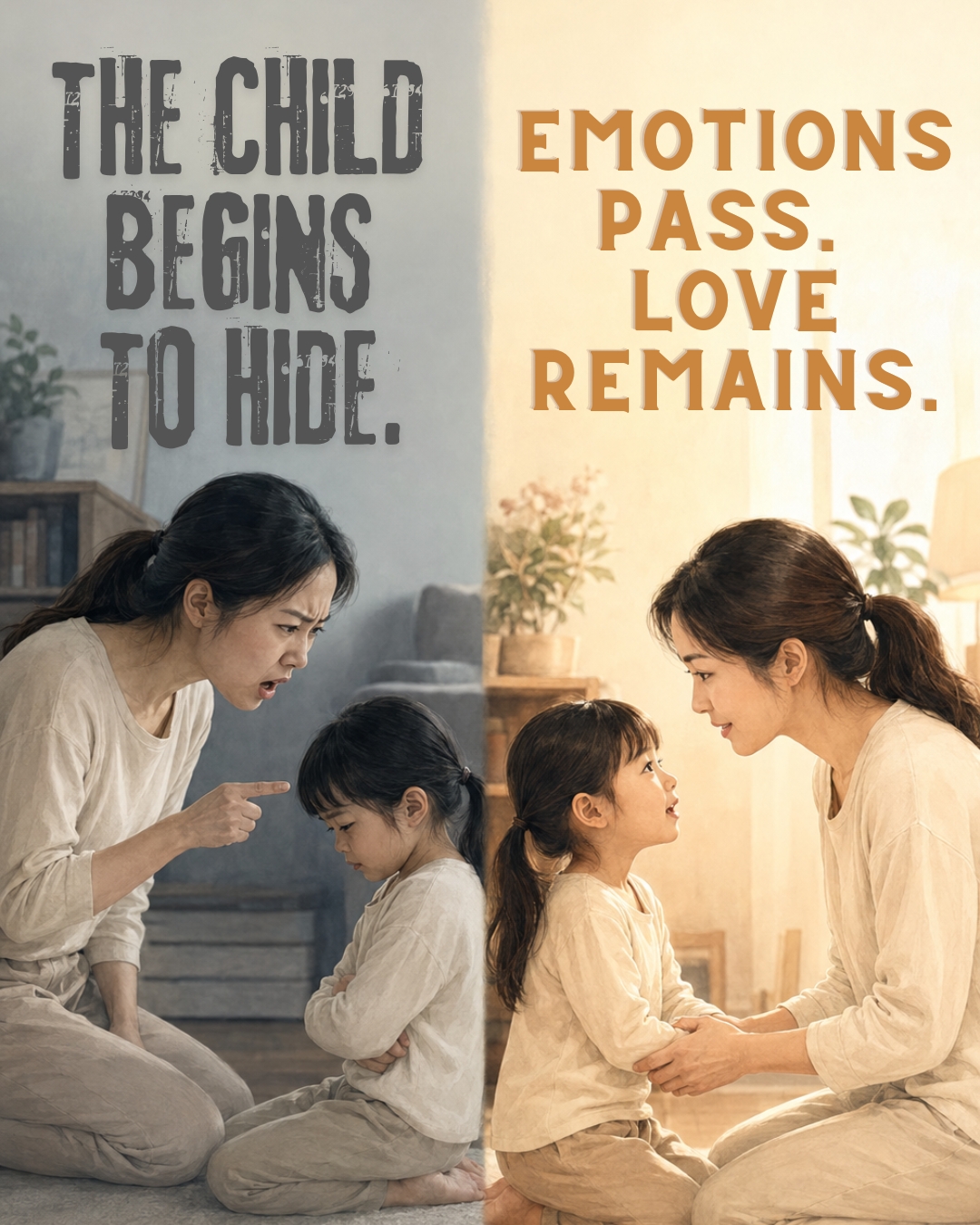
The Words Children Hear Become Their Inner Voice
The words children hear can slowly become their inner voice. Children absorb more than the lessons adults intentionally teach.
They notice tone of voice, facial expressions, reactions, beliefs, and the words spoken around them. Over time, these experiences may influence how children see themselves, express their feelings, and make choices.
A child may not understand why a parent is angry. Instead, the child may quietly wonder:
“Mummy is angry with me. Does that mean she does not love me?”
Two Different Responses
Imagine the same difficult moment with two different responses.
Response One: Fear
A mother becomes overwhelmed. She shouts, uses harsh words, or reacts physically.
The child becomes frightened and stops expressing what they think or feel. The behaviour may stop, but the child may not have learned the intended lesson.
Instead, the child may learn:
“It is safer to hide my thoughts.”
Silence does not always mean understanding. Sometimes, it means fear.
Response Two: Safety
A mother notices that her emotions are becoming too intense. She pauses and tells the child:
“Mummy is feeling angry and needs some time to calm down. But Mummy still loves you.”
The boundary remains, but the child’s sense of safety is protected.
The child begins to understand:
“Emotions can be strong, but love does not disappear.”
This also teaches the child that difficult feelings can be managed without hurting another person.
Guidance Is Not Control
Guiding a child does not mean shaping them into someone others expect them to be.
Healthy guidance provides love, support, boundaries, and enough space for a child to discover who they are.
Labels such as “naughty,” “difficult,” or “not good enough” can slowly become part of a child’s identity. It is more helpful to describe the behaviour without defining the child.
Instead of:
“You are a bad child.”
Try:
“That choice was not kind. Let’s think about what can be done differently.”
The behaviour can be corrected without making the child feel that something is wrong with who they are.
Words That Build Inner Strength
Simple words, repeated with sincerity, can help children build a safer inner voice:
- “I love you, even when I am upset.”
- “Your feelings are okay, but some actions are not.”
- “You can tell me what you think.”
- “Mistakes help you learn.”
- “You can try again.”
- “I am here when you are ready.”
One day, these words may become the words children say to themselves.
Raising a Child Is Like Growing a Flower
A flower needs sunlight, water, nourishment, and space.
Caregivers can provide the right environment, but they cannot decide the flower’s final shape, colour, or direction of growth.
In the same way, a child needs guidance and protection—but also the freedom to become who they truly are.
The purpose of parenting is not to create a perfect child. It is to provide a safe foundation from which a child can grow.
Preserving the Words That Matter
Childhood memories are not only found in photographs, milestones, and keepsakes. They also live in the words a child remembers hearing.
The Becoming You memory book was created to preserve these meaningful parts of a child’s journey—from early milestones and precious keepsakes to letters written by parents for the child to read in the future.
Because one day, a child may look back and remember not only what happened, but also how deeply they were loved, seen, and supported.
The words children hear today may become the voice they carry for life.
May that voice remind them:
You are loved.
You are capable.
You are free to become yourself.